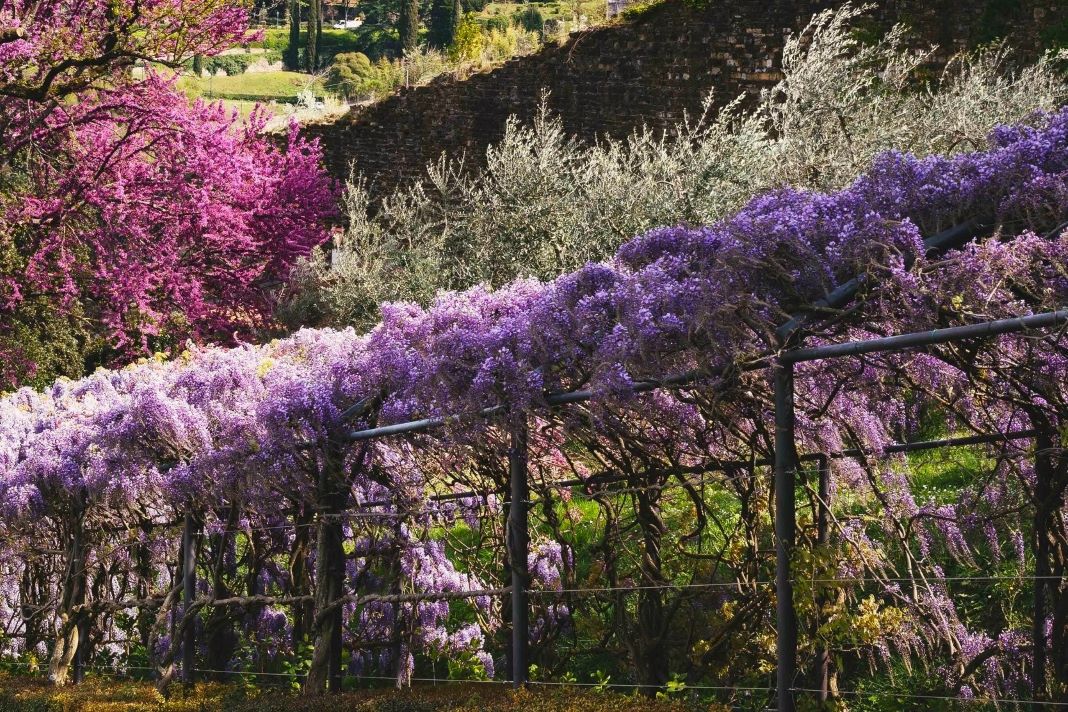
The Enchantment of Wisteria at Villa Bardini
Fri, 04/17/2026 - 13:10
Every spring, the magic of wisteria in bloom transforms the Garden of Villa Bardini into a riot of colors and fragrances, offering a unique and enchanting natural spectacle.
On the pergola of Villa Bardini, in fact, one of the most beautiful wisterias in the area comes into bloom. It is an enchanted tunnel, 70 meters long and 4.6 meters wide, with shades ranging from lilac to violet, from mauve blue to pink, which every year attracts thousands of visitors from all over the world.
The pergola is adorned with several varieties of wisteria from the collection of a nursery grower from Pistoia: Black Dragon (deep blue-violet in color), Royal Purple (a Japanese variety with an intense purple hue), Showa Beni (pink-toned), and the more common Wisteria Prolific (lilac-violet in color).
The spectacular wisteria bloom in the Garden of Villa Bardini is an event that lasts approximately 10–15 days.
Let’s get to know this plant better.
In the language of flowers, wisteria symbolizes friendship, beauty, longevity, and health.
Many stories and legends surround it: known and appreciated in China and Japan for over two thousand years, wisteria is considered the plant of friendship. It is said that emperors, during their travels, would carry small wisteria bonsai with them to offer as gifts of friendship and goodwill to the inhabitants of foreign lands.
An Italian legend tells instead of a young shepherdess named Glicine who, desperate about her appearance, began to cry in a meadow. At a certain point, her tears gave life to a marvelous plant with a spectacular bloom and an enchanting fragrance: the wisteria. Surrounded by its wonderful scent, the girl felt proud of herself for having created such a beautiful plant.
Among the most beautiful and admired climbing plants in the world, wisteria is extremely long-lived: one of the oldest specimens in Italy is over 700 years old, and legend has it that it even served as a source of inspiration for Leonardo da Vinci.
The first wisteria is said to have arrived in Europe in 1816, brought by the English captain Welbank. One May evening in 1816, he dined at the home of a wealthy merchant in Guangzhou (Canton), beneath a pergola of wisteria in full bloom - a plant the Chinese called Zi Teng, “Blue Vine.” No European had ever seen such a sight before, so Captain Welbank asked for some cuttings, which he took back to England and gave to his friend C. H. Turner in Rooksnest, Surrey. Three years later, in 1819, the wisteria bloomed there for the first time, and from that moment it spread rapidly through gardens all over the Old Continent.
In Italy, its presence is documented as early as around 1840.
One plant, different names.
Wisteria has many different names (glicine, wistaria, and wisteria), because so many stories are connected to this plant.
In Greek, glicine means “sweet plant,” and this name was given by Linnaeus to a climbing plant introduced from America in the early 18th century: the American wisteria (Wisteria frutescens). When, in the 19th century, Captain Welbank brought the Chinese wisteria we all know (Wisteria sinensis) to Europe, the botanist Nuttall did not immediately realize that the plant had already been classified a century earlier and named it Wistaria in honor of a German professor of anatomy and anthropologist named Kaspar Wistar.
In English pronunciation, however, this name was altered to Wisteria, and under this name it spread rapidly throughout European gardens. Even when the error was later recognized, Wisteria remained in use due to its widespread popularity.
Only in Latin countries such as Italy, France, and Spain has the original name glicine been preserved. The Germans even coined an entirely new name for it, Blauregen, meaning “Blue Rain,” inspired by its appearance when in bloom.
Experience the magic of wisteria with Firenzecard!
Follow the bloom live: https://www.villabardini.it/il-glicine/#webcam