A new room for the Chimera of Arezzo at the National Archaeological Museum of Florence
Mi., 03/04/2026 - 12:29
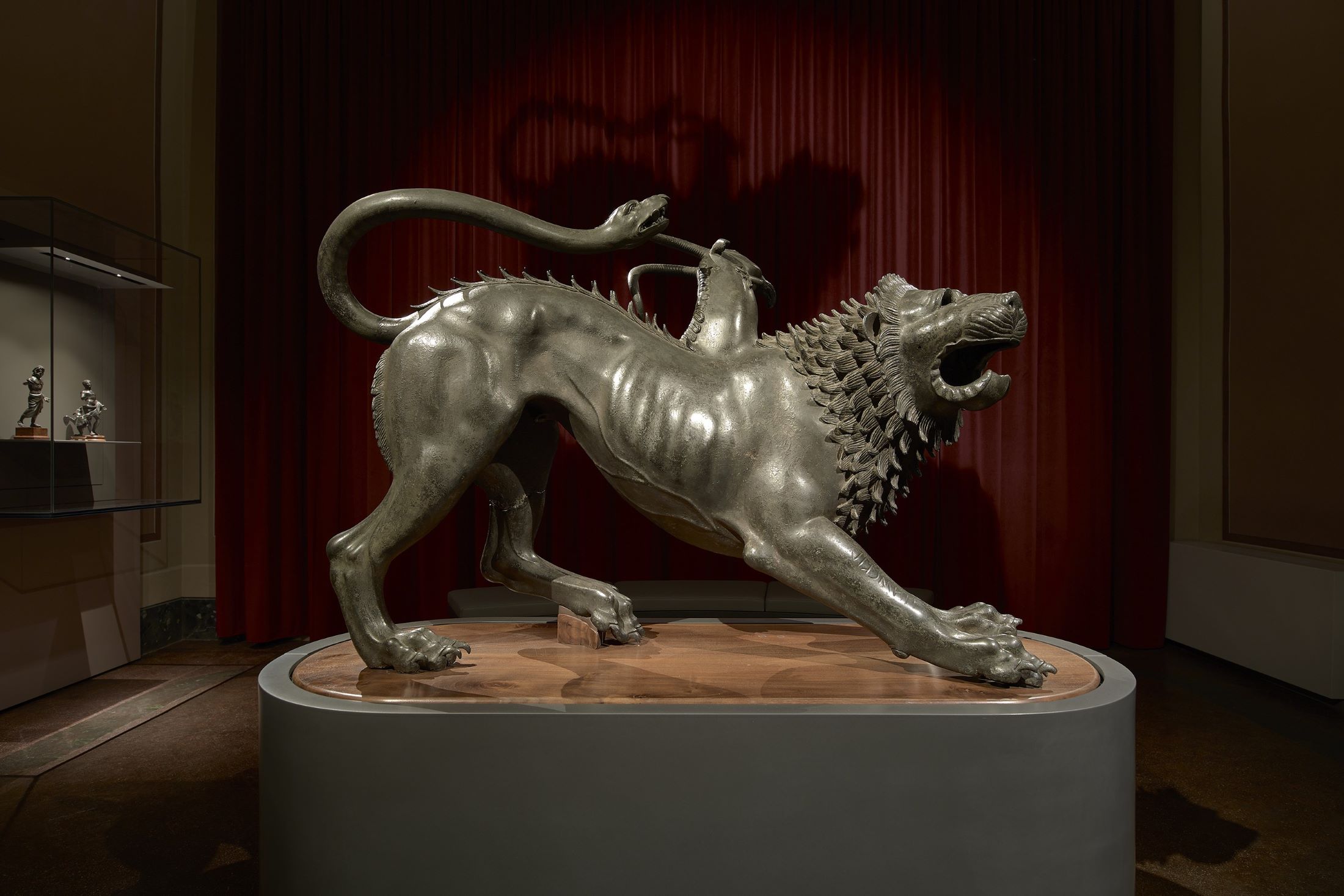
The National Archaeological Museum of Florence inaugurated the new Chimera Room, a fully renovated space dedicated to the Chimera of Arezzo, the most iconic and well-known Etruscan bronze. A scenographic redesign restores the Etruscan masterpiece to centre stage with an immersive and a circular layout, which invites visitors into an intimate encounter with the masterpiece, allowing the Chimera to be seen from every angle.
The work has long been considered the museum’s crown jewel: item no. 1 in its catalogue, it belonged to the future Grand Duke of Tuscany, Cosimo I de' Medici, ever since its discovery, and immediately became one of the most emblematic and valuable pieces in the Medici collection.
The experience inside the room is enriched by a suspended display case containing three small Etruscan bronzes, depicting a griffin, the Etruscan god Tinia (Jupiter), and a young donor. All come from the same context in which the Chimera was found, creating a silent dialogue between the works and their history.
The Chimera dominates the center of the room, resting on its monumental base. Its anatomical details and dramatic features are highlighted by the new lighting, featuring a skillful interplay of light and shadow, which conveys the vitality and historical depth of the myth surrounding it.
The bronze portrays the mythological creature in the moment of defeat by the hero Bellerophon. It is a composite beast: the body and head of a lion, a second head of a goat rising from its back and a serpent for a tail, though the original tail was never recovered. On one of its forelegs is the Etruscan inscription tinścvil, meaning “offering to Tinia”, identifying it as a votive offering dedicated in a sanctuary of ancient Arezzo.
The statue was found on November 15, 1553, during fortification works ordered by Cosimo I near Porta San Lorentino in Arezzo. Those present were captivated, as contemporary accounts suggest, by the vitality of its tense and by the arched form.
The Chimera enchanted also Cosimo I, who saw in Etruscan civilisation the symbol of a pre-Roman, proudly Tuscan identity. Striving to present his new Grand Duchy as heir to the ancient peoples of Etruria, he placed the Chimera in the halls of Palazzo Vecchio and even took part personally in the statue’s restoration. The sculpture quickly became a point of pride for the Medici court, praised by artists and intellectuals for its remarkable style, anatomical precision and expressive power.
In 1718, the Chimera was moved to the Uffizi by Cosimo III. With the end of the Medici dynasty, it was included in the Family Pact signed by Anna Maria Luisa de’ Medici in 1737, which ensured that the family’s collections, including the Chimera, passed intact to the new Grand Duke, Francesco Stefano of Lorraine, remaining permanently in Florence for the public benefit.
The statue entered the sphere of modern museum history in 1871, when it was transferred to the newly established Egyptian and Etruscan Museum, the first institution of its kind in Italy, created during Florence’s brief tenure as capital of the Kingdom of Italy. A decade later, in 1881, the entire collection found its home in the present-day headquarters of the National Archaeological Museum, at Palazzo della Crocetta, where the Chimera has remained one of its defining treasures.