The Prato Textile Museum celebrates 2 iconic French fashion designers
Di., 02/10/2026 - 11:10
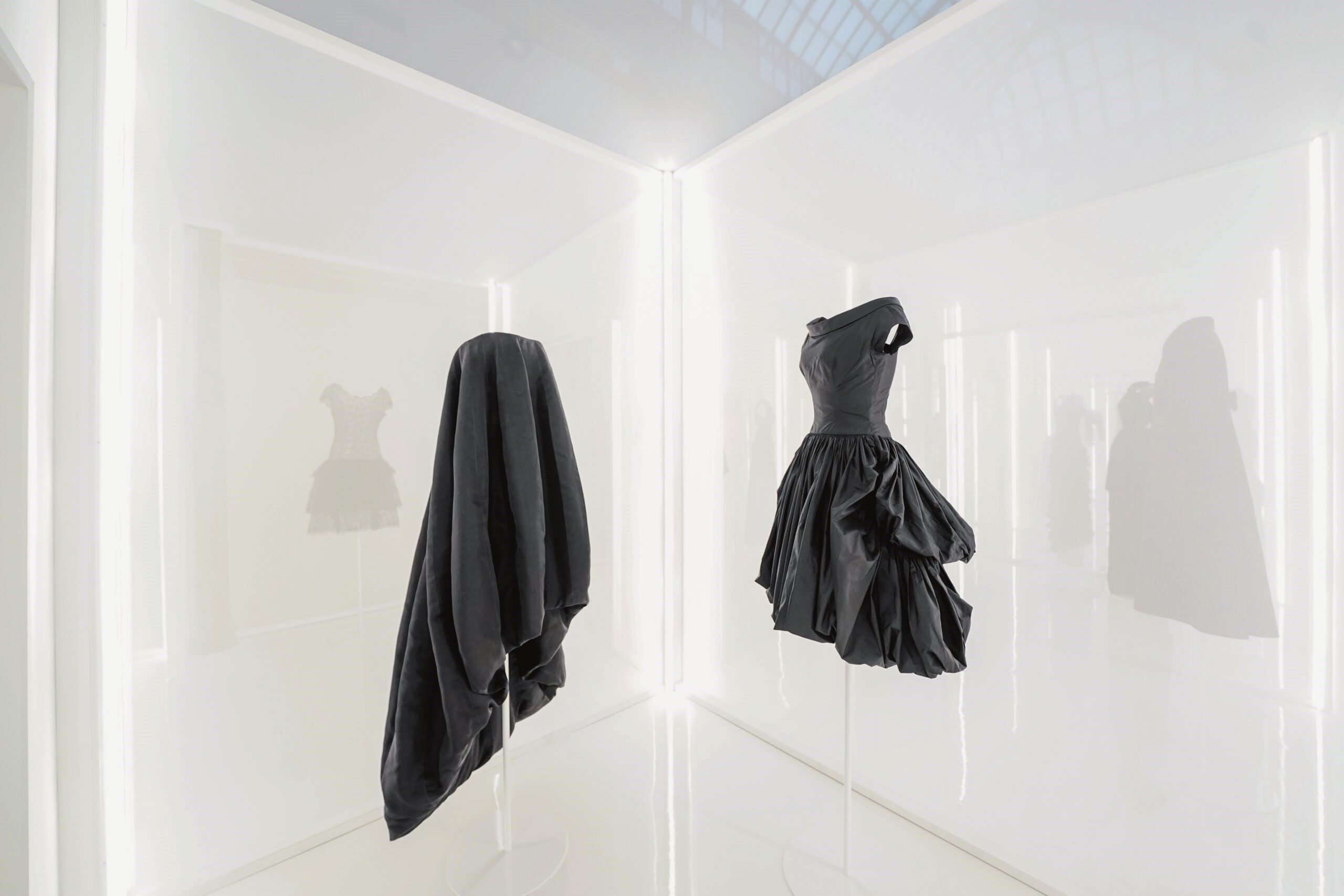
At the Prato Textile Museum, for the first time in Italy, "Alaïa, Balenciaga. Sculptors of Shape", a special exhibition project that celebrates 2 iconic French fashion designers.
The exhibition is open until May 3, 2026.
The idea for the exhibition came from Hubert de Givenchy in 2020, wishing to bring together two historic talents of French haute couture. The exhibition compares the creativity of the two designers through a core collection of fifty dresses from the Azzedine Alaïa Foundation with original documents and videos from the Balenciaga Archive, housed in the rooms of the former Campolmi factory.
Twenty-five creations by Balenciaga and twenty-five dresses by Alaïa are displayed in dialogue, centered on the color black, in a timeless encounter between two masterful experimenters with shapes and volumes. For Balenciaga, black represented the quintessence of elegance, lending majesty to both daywear and evening gowns. For Alaïa, however, black was a style statement, a striking hue that exalted the sensuality of the female body, sometimes paired with brighter colors in refined contrasts of light and texture.
Enriching and completing the exhibition are a film on the life and work of Azzedine Alaïa, directed by fashion editor and stylist Joe McKenna, and a previously unseen video featuring the presentations of Balenciaga's Summer 1960 and 1968 Haute Couture collections, from the Balenciaga Archives in Paris.
Let's discover together why the exhibition is dedicated to these two figures.
The stories of Alaïa and Balenciaga are strikingly similar. Both were not born in Paris—Balenciaga in Getaria, in the Basque Country, in 1895; Alaïa in Tunis, in 1935—and took their first steps among needles and fabrics, thanks to their respective families: for Balenciaga, it was his mother Martina, a seamstress to the Spanish nobility; while for Alaïa, it was his sister Hafida, from whom he learned the art of sewing. They shared the idea that technical knowledge is the foundation of art and the conviction that the female body should not be decorated, but sculpted.
Their great talent brought them both to Paris: Balenciaga, forced to close his Spanish ateliers due to the Civil War, moved to Paris and opened his first fashion house on Avenue George V in 1937, quickly becoming one of the most beloved designers among the European aristocracy for his balance between constructive rigor and sculptural grace. Alaïa, on the other hand, moved to Paris in 1957, after working as a tailor's assistant in Tunis. He was immediately noticed and hired by Christian Dior, and went on to work alongside Guy Laroche and Thierry Mugler before opening his own atelier, which would become a hub for aristocrats, models, and Hollywood divas, drawn to his almost anatomical approach to couture.
Both designers, having reached the pinnacle of their success, retreated from the spotlight. Alaïa, after dedicating himself to his private circle of clients, returned to the catwalk in the early 2000s, ushering in a second period of glory that concluded in 2017 with the presentation of his final haute couture collection.
Form as the architecture of the body is undoubtedly the affinity that most closely unites the two designers: both conceive of fashion as an exercise in construction, transforming the body into a living sculpture. For Balenciaga, fabric becomes architectural material, capable of creating suspended volumes that protect and distance the body. With Alaïa, however, the fabric adheres to the skin, follows it, shapes it until it becomes a tactile landscape, a second epidermis. Furthermore, both master every phase of creation, from design to cutting, from construction to tailoring.
Their affinity materializes in a key episode: in 1968, the year Balenciaga decides to close his fashion house, the young Alaïa is invited by the house's deputy director to view some creations preserved in the Spanish master's archives. Faced with those works of art, Alaïa is transfixed and from that moment on he considers Balenciaga a point of origin, a silent presence that will forever accompany his research.
Visit it with Firenzecard!