What to do in Florence in December?
Thu, 11/19/2026 - 12:35
Florence in winter has a special charm: less hustle and bustle, Christmas lights illuminating the streets, museums to explore at a leisurely pace, and that cozy atmosphere that invites you to slow down and enjoy every moment.
It’s a time of small wonders, smiles, wishes, and anticipation. A time when everything is cloaked in magic and even the simplest things become special.
Here are 3 good reasons to visit Florence in December:
• Experience the Christmas spirit through the great masterpieces of art related to the themes of the Nativity and the Adoration.
• Experience the magic of Christmas in the city’s streets. The streets of the city center light up, store windows are decked out for the holidays, and light installations on monuments and throughout the city’s neighborhoods romantically transform the cityscape.
• Draw inspiration from decorations, handmade crafts, and gift ideas at the Christmas markets that fill the city.
Admission tickets and reservations for all the museums included in this itinerary are covered by the Firenzecard.
Shop now your Firenzecard!
Where can you admire Nativity scenes?
Florence’s museums house extraordinary masterpieces related to the themes of the Nativity and the Adoration. Every Renaissance artist reinterpreted this sacred moment, infusing it with unique styles, lighting, and theological nuances.Here’s where to find the most famous Nativity scenes and Adoration paintings in the city’s museums:
1. Uffizi Gallery
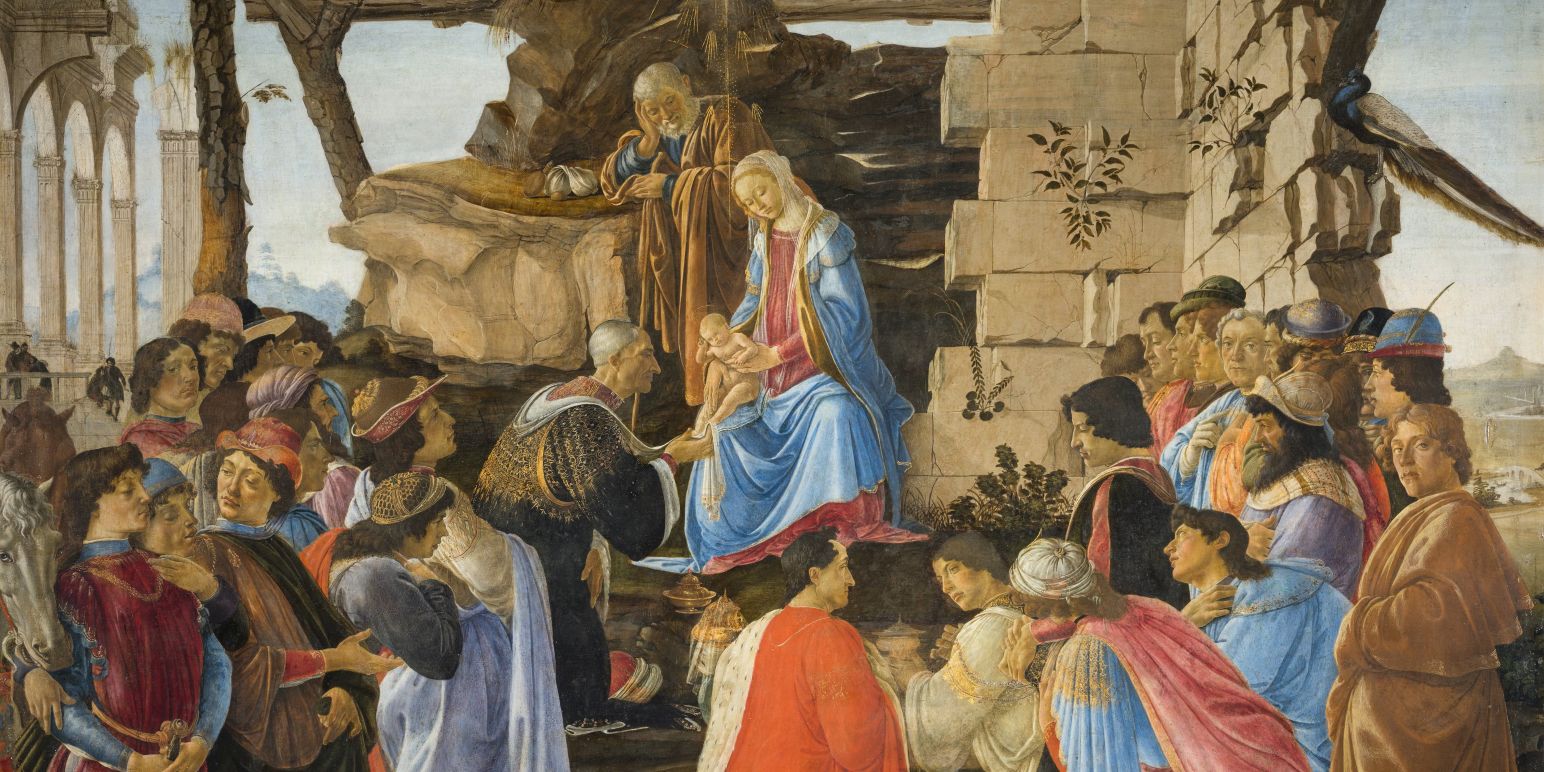
The Uffizi houses the largest concentration of masterpieces dedicated to this theme:- Botticelli’s Adoration of the Magi: In this work, Sandro Botticelli transforms the Nativity theme into a parade of figures from Florentine society during the years when the Medici family was rising to power. The infant Jesus blesses the Magi kneeling at his feet, one of whom bears a resemblance to Cosimo the Elder de’ Medici; the other two Magi likely resemble Cosimo’s sons: Piero the Lame, cloaked in red and kneeling in the center of the foreground, and Giovanni, standing beside him dressed in white.
- The Portinari Triptych by Hugo van der Goes: A monumental Flemish work that arrived in Florence in 1483. Its Nativity scene, characterized by raw realism and minute details (such as the shepherds with gnarled hands), profoundly influenced the Florentine painters of the time.
- Leonardo da Vinci’s Adoration of the Magi: The famous unfinished masterpiece, in which the sacred scene is immersed in a whirlwind of figures, emotions, and complex architectural backgrounds. For this work, Leonardo devised a highly complex composition, rich in figures, arranged in a semicircle centered on the Virgin and Child. In the foreground, the Magi kneel, bearing gifts of gold, frankincense, and myrrh to Jesus. Leonardo paints a backdrop featuring crumbling architecture and clashes between horses and knights; on the left is depicted the construction of a building—perhaps a temple—symbolizing peace.
- The Adoration of the Magi by Gentile da Fabriano: The pinnacle of International Gothic in Italy, opulent and rich in gold, precious garments, and exotic animals. After a long journey, the Magi arrive in the presence of the newborn Messiah, guided by the comet, and prostrate themselves at the feet of the Holy Family, offering precious gifts. Dressed in extraordinarily rich and fashionable garments, the Magi are accompanied by a multiethnic procession, which also includes exotic animals, evoking their origins in the Far East. The Magi’s journey—from the sighting of the comet to their stop at King Herod’s palace, and finally their return home—is depicted in three distinct episodes set against the backdrop of the composition.
- Adoration of the Child by Gerrit van Honthorst (Gherardo delle Notti): A 17th-century masterpiece in which light seems to emanate directly from the body of the Infant Jesus, illuminating the faces of Mary and Joseph. A moving work in which the divine light radiating from the Child renders every feature gentler and more suffused, caressing the Virgin’s face in particular. On the right side of the canvas, Saint Joseph leans on his staff, gazing at the Child with an expression that blends love and joy. The gaze of the two little angels on the left is filled with deeply human emotion.
- Adoration of the Magi by Albrecht Dürer: A splendid example of the fusion between the Italian Renaissance and the geometric and naturalistic precision of the North. The color choices also stand out: in the foreground, red, green, and blue; in the distance, the azure of the sky and the blue of the sea, with a palette that becomes light and luminous, opening up to a somewhat fairy-tale-like landscape, featuring the knights and the village in the distance.
2. Museo degli Innocenti
- Domenico Ghirlandaio’s Adoration of the Magi: Painted for the church of the Spedale, this work is rich in portraits of figures from Florence at the time and includes a famous predella filled with narrative details. Dedicated to the Nativity, it depicts the construction of the Spedale degli Innocenti and highlights the institution’s connection to the city and its new role in protecting children.
3. Palazzo Medici Riccardi
- The Adoration of the Magi by Benozzo Gozzoli: Commissioned by the Medici family in 1459, this work adorns the walls of the Chapel of the Magi. The journey of the three Magi to Bethlehem commemorates the Council of Florence in 1439 and the arrival in the city of Pope Pius II’s papal procession. Among the figures depicted, we can recognize the faces of illustrious members of the Medici family, including Lorenzo the Magnificent, Piero the Lame, and Cosimo the Elder, alongside Byzantine dignitaries and a self-portrait of the painter himself. The narrative unfolds against a fairy-tale landscape rich in courtly details, sumptuous garments, and precious pigments.
4. Galleria Palatina (Palazzo Pitti)
Within the sumptuous Baroque halls of Palazzo Pitti, the Medici Collection preserves works of extraordinary intimacy and beauty:- Raphael’s Madonna della Seggiola and Madonna dell’Impannata: Although not strictly depictions of Christmas Night, they celebrate sacred motherhood and the Holy Family with the unmistakable grace of the master from Urbino.
- Pontormo’s Adoration of the Magi: An early work charged with the tension and energy characteristic of Florentine Mannerism, where the sacred event is animated by figures draped in vibrant, flowing garments.
5. Museum of San Marco
This ancient Dominican convent is a treasure trove of spirituality and Early Renaissance art, closely linked to Fra Angelico:- Adoration of the Magi: An extraordinary fresco located in the cell historically reserved for Cosimo the Elder de’ Medici. Fra Angelico painted it so that the ruler of Florence could meditate on the humility of the powerful Eastern kings in the presence of the Child.
- Armadio degli Argenti: A series of wooden panels painted by Fra Angelico himself, illustrating the Life of Christ; among these, a particularly tender Nativity and the iconic Adoration stand out.
6. Bargello National Museum
This temple of Renaissance sculpture houses sculptural masterpieces dedicated to Christmas:- The glazed terracotta works by Luca and Andrea della Robbia: The Bargello boasts an exceptional collection of white and blue ceramic reliefs depicting the Nativity, where the purity of the materials and the gentleness of the faces perfectly evoke the Christmas spirit.
- The Nativity relief by Donatello and his workshop: Small, exquisitely crafted bronzes and marbles that showcase the mastery of the “stiacciato” technique applied to nativity scenes.
7. Accademia Gallery
It’s not just Michelangelo’s David; the museum’s art collection houses medieval and late-Gothic treasures related to the theme of the birth of Christ:- Scenes from the Life of Christ by Taddeo Gaddi: 14th-century painted wooden panels (which once formed the doors of the sacristy cabinets at Santa Croce) that depict both the Nativity and the Adoration of the Magi with Giottesque delicacy.
What are the main Christmas markets in Florence?
Here is a list of the main Christmas markets you can find in the city:1. Christmas Market – Piazza Santa Croce
November 14 – December 20, 2026
This is Florence’s largest and most famous Christmas market, featuring over 50 German-style wooden stalls.
• Handicrafts and Christmas decorations
• Pastries, pretzels, sausages, and mulled wine
• Gift ideas and European products
2. Joulutori – Nordic Market
November 28 and 29, 2026
At The Social Hub, Viale Spartaco Lavagnini 70.
• Nordic crafts
• Design and decorations
• Gastronomic specialties
3. Fierucola dell'Immacolata
December 8, 2026
Piazza Santissima Annunziata.
• Tuscan crafts
• Natural and traditional products
• Small producers and master artisans
4. Nataleperfile – Palazzo Corsini
December 11, 12, and 13, 2026
Lungarno Corsini 8.
• Over 30 exhibitors
• Clothing, accessories, and design
• Gourmet foods and fair-trade gifts
5. Christmas Fierucola
December 20, 2026
Piazza Ognissanti.
• Handicrafts and local products
• Gift ideas
• Traditional products
6. Fierucolina Natalizia
December 13, 2026
Piazza del Carmine, in the Santo Spirito neighborhood. A smaller-scale market dedicated to artisanal and traditional products.
What else to say?
December is the perfect time to let yourself be captivated by the charm of Florence. During the Christmas season, this city is adorned with lights, colors, and magic, creating a unique atmosphere among its picturesque alleys, illuminated squares, and Christmas markets.Each day offers a chance to immerse yourself in art and beauty, visiting museums, historic palaces, and timeless masterpieces. And when evening falls, a stroll between the Ponte Vecchio, Piazza della Signoria, and Piazza Duomo makes it all even more special.
Florence in December is a journey through culture, emotions, and Christmas magic—one to be savored at a leisurely pace and remembered for a long time to come.