The San Marco Museum and the relationship between art, spirituality, and the Renaissance
Fri, 11/20/2026 - 12:51
The San Marco Museum tells the story of the Florentine Renaissance through the spaces of an ancient convent built to house a community of friars, yet still capable today of conveying a sense of daily life from that era.
The complex originally housed a community of Sylvestrine monks, but its history changed when, in 1436, Pope Eugene IV ordered its transfer to the Observant Dominicans. This handover marked the beginning of a new phase for San Marco. The convent, in fact, was in a state of disrepair and required a major overhaul to adapt it to the needs of the Dominican community. It was Cosimo de' Medici, known as Cosimo the Elder, who promoted its renovation, entrusting the project to the architect Michelozzo.
Work began in 1437 and continued in the following years until the main structures of the complex were completed. The project involved the church, the cloisters, the communal spaces for the friars, the cells, and the library, organizing the environments according to the needs of the Dominican community. Michelozzo thus shaped a convent where the architecture catered to religious life while simultaneously reflecting the new visual language of the early Renaissance. Even today, when visiting San Marco, it is possible to read this relationship between spatial organization, spirituality, and artistic culture.
Generally speaking, Medici patronage held both religious and public value. In the fifteenth century, financing the renovation of a church or a convent was a way to support the city's religious life, but also to make one's role in Florentine society highly visible. With his contribution to the renovation of the Dominican convent, Cosimo de' Medici was able to consolidate his family's ties with the religious community.
In 1438, alongside his brother Lorenzo the Elder, they acquired the patronage rights to the church's main chapel. In practice, they took on the role of protectors and financiers of that space, supporting its renovation. The architectural intervention was entrusted to Michelozzo, while the painted decoration and the altarpiece involved Fra Angelico.
Today, the museum itinerary allows visitors to walk through a significant portion of the convent complex. The Cloister of Sant'Antonino introduces the communal areas, while the chapter house preserves one of Fra Angelico's most famous works, the large Crucifixion with Saints. The library, designed by Michelozzo, stands as a testament to the importance placed on study in the friars' formation and how closely intertwined fifteenth-century artistic culture was with the institutions and life of the community.
Fra Angelico's frescoes: what makes the visit unique
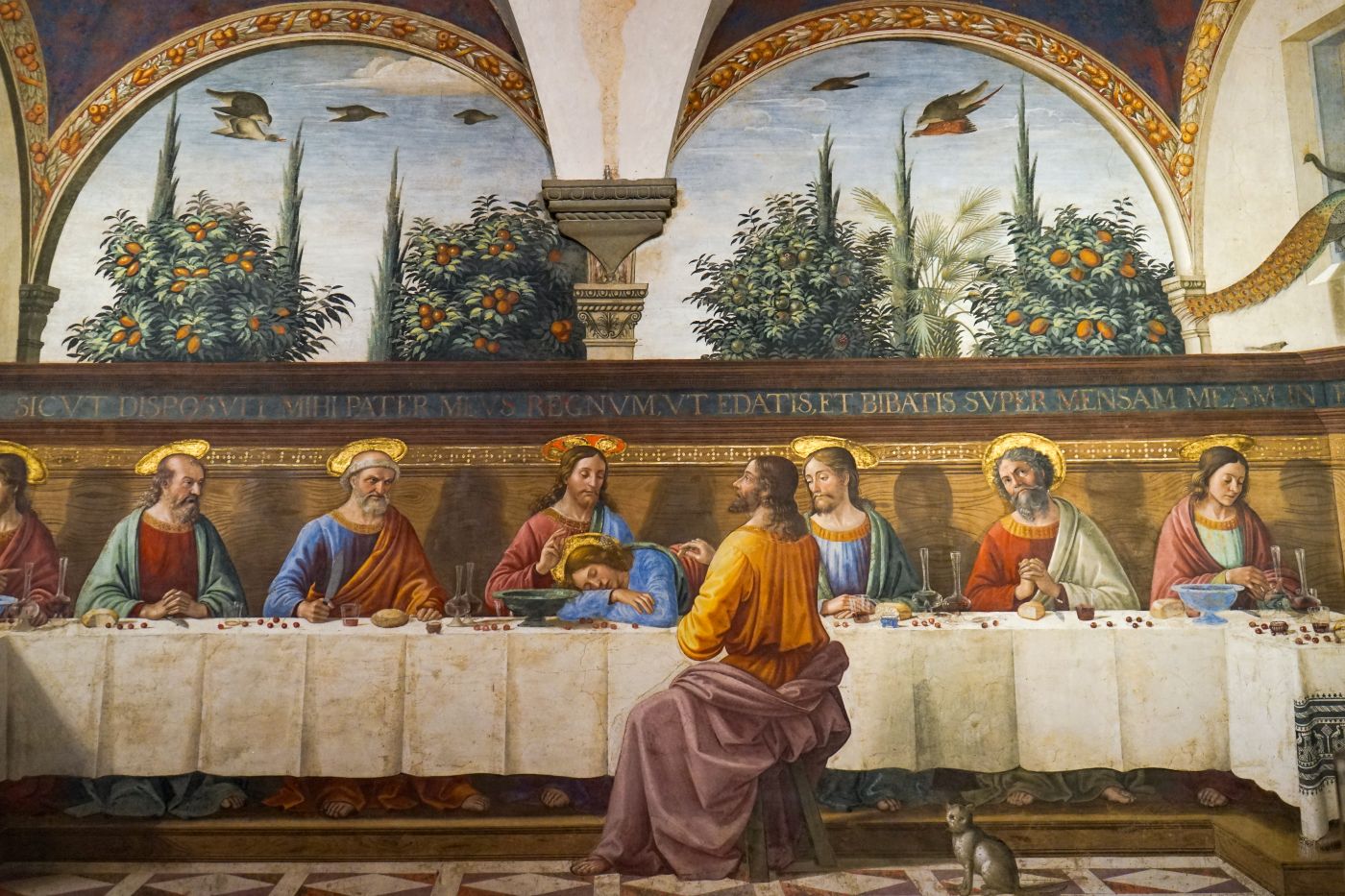
Fra Angelico's frescoes form the most recognizable core of the San Marco Museum. The painter carried out most of the convent's decoration in the 1440s, painting images intended to accompany the friars' prayer and meditation. Specifically, his works are found in various areas, especially along the corridors and inside the cells, where each image was designed to be contemplated during the community's daily life.The choice to place frescoes inside the cells makes the tour particularly special. Each friar had a personal space for rest and prayer, often decorated with a scene from the life of Christ or a sacred image. The compositions are generally minimalist: few characters, measured gestures, and settings that leave room for contemplation. Fra Angelico's painting thus adapts to the function of the spaces, guiding meditation without distracting with superfluous details.
Among the most famous works is the Annunciation, painted at the top of the stairs leading to the dormitory floor. Here, Mary and the angel are depicted in an austere loggia, characterized by slender columns and clear lighting. The scene invites the viewer to linger on the moment of the announcement, while the painted architecture echoes the order and simplicity of the convent's actual physical spaces. It is one of the most representative images of Fra Angelico's visual language and his way of blending perspectival research with religious sensitivity.
Another central work is the Crucifixion in the chapter house. The composition gathers Christ on the cross, the Virgin Mary, the saints, and numerous figures linked to the Dominican tradition. The fresco differs in size and function from the images in the cells: it was intended for a communal space, where the friars gathered for the order's activities. The presence of Dominican figures directly connects the sacred scene to the history of the community that inhabited the convent.
From the San Marco Museum to other Renaissance masterpieces with FirenzeCard
The San Marco Museum provides insight into a dimension of the Renaissance that often remains in the background of the most popular tourist itineraries. The cells frescoed by Fra Angelico, the library designed by Michelozzo, and the quarters of the Dominican community reveal the relationship between artistic production, spirituality, and humanistic culture in fifteenth-century Florence.The visit takes on even greater meaning when included in an itinerary featuring other masterpieces of the era, such as the San Lorenzo complex, Palazzo Medici Riccardi, and the Accademia Gallery, as well as the Uffizi and Palazzo Vecchio.
Each location showcases a specific aspect of Renaissance Florence. The Uffizi Galleries trace the development of painting through the works of artists like Botticelli, Leonardo, and Michelangelo. Palazzo Medici Riccardi highlights the Medici family's role in the city's political and cultural life, while the Basilica of San Lorenzo houses testaments to the relationship between architecture, sculpture, and patronage. San Marco adds the perspective of convent life and Fra Angelico's religious painting to this journey.
To plan multiple visits and discover the city's main cultural institutions, you can choose the FirenzeCard, the official tourist pass that grants access to numerous participating museums and cultural sites. It is an ideal solution for those who want to dedicate their stay to exploring Florence's artistic heritage, building an itinerary through museums, historic palaces, and iconic landmarks of the Renaissance.
Are you planning a visit to Florence?
Discover all the benefits of the FirenzeCard, check the included museums, and choose the best option for your stay. Purchase your FirenzeCard and start exploring the city's artistic heritage.